
Language
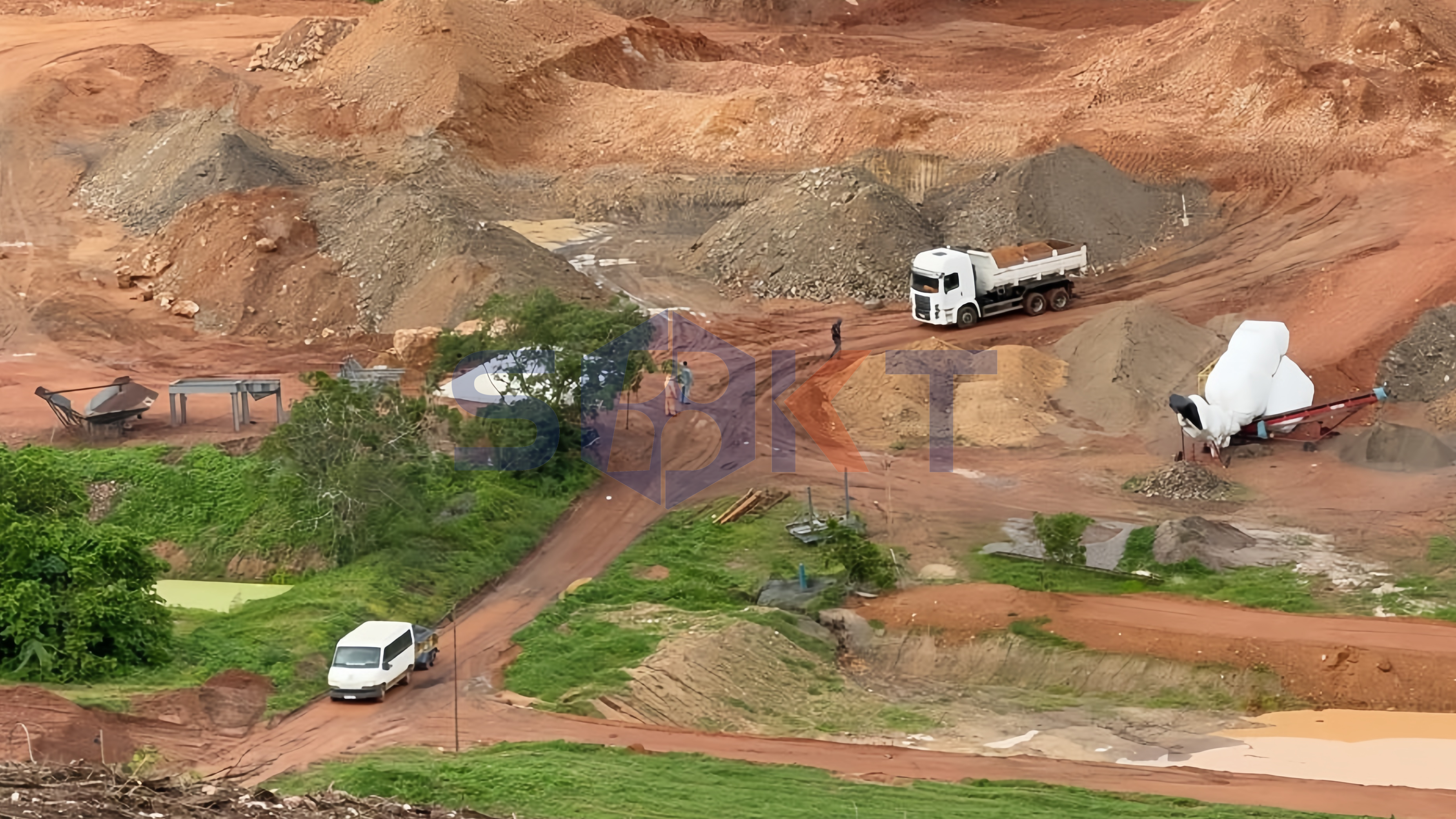
The key to selecting a gold beneficiation method is to balance grade, ore properties (such as gold particle size, occurrence, and associated minerals) with economic efficiency. Different grades of gold ore require different beneficiation methods due to differences in “recoverable value” and “processing difficulty.” This article will share the beneficiation methods and selection logic for different gold ores, based on ore grade classification (low, medium, and high) and ore characteristics.
Ⅰ. Low-Grade Gold Ore (typically <1g/t): Prioritize “Low-Cost, Low-Energy” Processes
The core issue with low-grade gold ores is the need to control processing costs due to the low value of the ore. Therefore, a method with simple processes and low energy consumption is required, and recovery requirements can be appropriately lowered (typically 50%-70% is profitable).
Applicable Scenarios and Methods:
1. Oxide Ore/Loose Ore (Gold Easily Dissociates)
Advantages: Equipment investment is only 1/5-1/10 of flotation, energy consumption is extremely low (no grinding step), and it is suitable for large-scale processing of low-grade ores.
Limitations: If the ore contains high clay content (which can block seepage) or high sulfide content (which consumes reagents), pretreatment (such as airing and the addition of inhibitors) is required.
Heap Leaching: No fine grinding is required (only coarse crushing to 20-50mm). The ore is piled in an impermeable dump and sprayed with cyanide (or an environmentally friendly agent such as thiourea). The leachate is then adsorbed on activated carbon to recover the gold. 2. Placer Gold Ore (Predominantly Coarse-Grained Free Gold)
Gravity Separation (Simplified Equipment): After crushing and grinding, the ore is separated using equipment such as jigs and chutes, utilizing the density difference between gold and gangue. Because gold particles in placer gold ore are relatively coarse (mostly >0.074mm), gravity separation recovery rates can reach 60%-80%, and the cost is only one-third of heap leaching (no chemicals are required).
II. Medium-Grade Gold Ore (1-5g/t): Balancing Recovery and Cost, Prioritizing Efficient Separation
Medium-grade gold ores are the mainstay of industrial production. With medium ore value, costs must be controlled while maintaining a recovery rate (typically 80%-90%). The method of choice depends heavily on the gold’s occurrence.
Applicable Scenarios and Methods:
1. Primarily Coarse Free Gold (>0.074mm)
Advantages: Gravity separation offers low cost (no reagents required), with coarse gold recoveries exceeding 90%, making it suitable for quartz vein-type gold deposits (where gold is mostly in a free state).
Gravity separation (enhanced process): After crushing, the ore is ground to 200 mesh (~0.074mm accounts for 60%). Coarse gold is recovered using equipment such as shaking tables and centrifugal concentrators. The tailings can then be recovered using flotation or cyanidation to recover fine gold (i.e., combined gravity separation and flotation).
2. Fine-grained disseminated gold (<0.037mm, often encapsulated by sulfide ore)
Advantages: Fine-grained gold recovery rates can reach 85%-95%. After flotation enrichment, only a small amount of concentrate needs to be processed for subsequent cyanidation, reducing overall costs.
Flotation: Grind the ore to a -200 mesh size, with a minimum of 80% (to fully dissociate the gold). Add a collector (such as xanthate) to float the gold-bearing sulfide ore into a concentrate (raising the grade to 20-50g/t). The concentrate is then subjected to cyanidation for gold extraction.
3. Oxidized-sulfide mixed ore
Heap leaching-flotation combined process: Heap leaching is performed first to treat the easily leached oxide ore (recovering 30%-40%). The residue is then flotated to recover the gold encapsulated in the sulfide ore (raising the overall recovery to 70%-80%).
Ⅲ. High-Grade Gold Ore (>5g/t): Prioritize “High Recovery” Processes with High Cost Tolerance
High-grade gold ores are highly valuable, and the core objective is “maximum gold recovery” (recovery rate >90%). Complex processes or a combination of multiple methods can be employed, with cost being a secondary factor.
Applicable Scenarios and Methods:
1. Coarse and Fine Mixed Gold
Combined Gravity Separation and Cyanide Process: First, gravity separation is used to recover coarse gold (to avoid subsequent grinding losses). The tailings are then ground to -325 mesh (to dissociate the fine gold). Cyanide leaching is then used for recovery, achieving a total recovery rate exceeding 95%.
2. Fine Encapsulated Gold (<0.01mm, encapsulated by sulfides/silicates)
Advantage: Even tightly encapsulated gold can be broken through pretreatment, achieving recoveries of 90%-93%. This method is suitable for high-grade, difficult-to-process gold ores (such as arsenic-bearing gold ores). Flotation-roasting-cyanidation combined process: First, flotation is performed to enrich the ore into a high-grade concentrate (grade 50-100g/t), then roasting (oxidation of sulfide ore) or bio-oxidation (decomposition of inclusions) is used to expose the gold, and finally cyanide leaching is performed.
IV. Key Considerations: Grade is Not the Only Criterion
Ore properties take precedence over grade. For example, low-grade (0.8g/t) oxide ore with readily dissociated gold can be profitably processed using heap leaching. However, high-grade (6g/t) ore with gold densely encapsulated by silicates may yield less than 50% recovery if directly cyanided, necessitating roasting (increasing costs).
Economic analysis determines the final choice: For medium-grade gold ores with excessive flotation reagent costs (e.g., due to the presence of numerous interfering minerals such as copper and lead), gravity separation combined with heap leaching may be an alternative. For high-grade gold ores with a high proportion of coarse gold, gravity separation can be simplified (without the need for complex processes).
In general, low-grade gold is separated using low-cost processes (heap leaching and simple gravity separation), medium-grade gold is separated using efficient separation based on gold particle size (gravity separation and flotation), and high-grade gold is separated using a high-recovery combined process (gravity separation – cyanidation, flotation – pretreatment). The key is to determine the optimal “recovery-cost” balance through testing based on ore characteristics.
Fill in the information and we will contact you as soon as possible