
Language
Against the backdrop of depleting natural sand resources and increasingly stringent environmental regulations across the aggregate industry, manufactured sand has become the mainstream material for modern construction projects. Faced with a wide range of sand making machines on the market, many investors struggle to make the right choice. Hammer crushers, double roll crushers and VSI vertical shaft impact crushers are the three most popular types of manufactured sand production equipment currently available. Each machine boasts unique features and is designed for distinct working conditions. This guide conducts an in-depth comparative analysis from four key aspects: working principle, finished product quality, operational cost and applicable scenarios, to help you select the ideal sand making equipment.
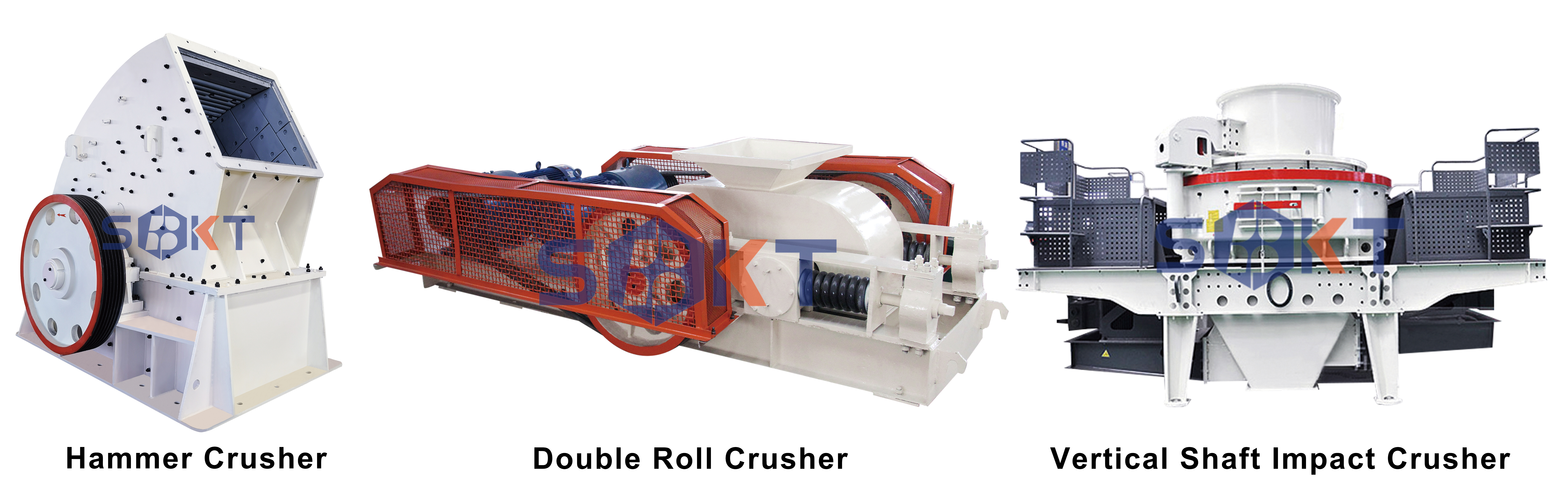
To pick suitable crushing equipment, it is essential to first understand its crushing principle, which directly determines applicable raw materials and final sand quality.
The hammer crusher relies on high-speed rotating hammers to strike, shear and grind raw materials. It features one-step forming and a large crushing ratio, which can crush large stones directly into finished sand with a simple production process. Nevertheless, its powerful impact force will cause relatively severe damage to raw materials during processing.
The double roll crusher operates with two counter-rotating rollers to crush materials through compression and shearing force, also known as inter-layer crushing. This static pressure crushing method is mild. Raw materials break along their natural texture, resulting in minimal over-crushing and controllable fine powder content.
The VSI sand making machine adopts two working modes: rock-on-rock and rock-on-iron. Raw materials collide violently at high speed inside the crushing cavity. It delivers outstanding crushing efficiency and powerful particle shaping performance, making it the core equipment for producing high-quality manufactured sand.
The particle shape, gradation and fineness modulus of manufactured sand are critical factors affecting concrete quality, and serve as core reference indicators for equipment selection.
Sand produced by the VSI crusher features cubic particles with smooth edges and corners, extremely low flaky and elongated particle content, and adjustable fineness modulus. Its finished products fully meet the standards for Class I construction sand. This equipment is widely applied in expressways, high-rise buildings and other projects that require excellent workability and high strength of concrete.
The double roll crusher produces sand with smooth particle shape and reasonable continuous gradation. Its particle shaping effect is not as good as the VSI crusher but outperforms the hammer crusher. Its finished products fully satisfy the requirements for general building masonry and road bedding. Besides, the fine powder content can be easily controlled by adjusting the roller gap.
Due to intense impact crushing, the finished sand from hammer crushers contains a large number of flaky and elongated particles and numerous internal micro-cracks. Its particle size distribution is scattered with excessive fine materials and severe over-crushing. When this type of sand is used for high-grade concrete production, it will increase cement consumption and even compromise concrete strength.
When investing in sand making equipment, buyers should focus not only on the initial purchase price but also on long-term operating costs.
The roller shells of double roll crushers wear evenly and have a long service life, and the machine is equipped with iron passing protection devices. Statistics show that its overall operating cost is over 30% lower than that of hammer crushers. With an open structure and smooth discharging performance, it adapts well to raw materials with high moisture content or slight mud content and rarely suffers from material blockage.
The hammer crusher has an affordable equipment price and a low entry threshold for initial investment. However, its major drawback is the rapid wear of hammers and liners. When processing high-hardness stones, these vulnerable parts need frequent replacement, leading to high maintenance costs and long downtime. In addition, it has strict requirements on raw materials and is not suitable for materials with moisture content above 5%, otherwise the sieve plate will be blocked easily.
The VSI crusher adopts advanced technology and requires relatively high initial investment. It is fitted with high-performance wear-resistant components and hydraulic top-opening devices for convenient maintenance. Although the cost of wear parts is relatively high, its large production capacity and high added value of premium finished sand bring the best comprehensive economic benefits for large-scale sand production lines.
|
Comparison Dimension |
Hammer Crusher |
Double Roll Crusher |
VSI Vertical Shaft Impact Crusher |
|
Applicable Raw Materials |
Medium & low hardness brittle dry materials (limestone, coal) |
Medium & low hardness sticky and wet materials (gangue, clay, gravel) |
All types of stones with different hardness (pebble, granite, basalt) |
|
Finished Particle Shape |
Average, high flaky particles and fine powder |
Good, smooth particles and reasonable gradation |
Excellent, cubic shape, continuous gradation & strong shaping |
|
Raw Material Moisture Sensitivity |
Highly sensitive (<5%), easy to block |
Low sensitivity, suitable for wet materials |
Strong adaptability |
|
Operating Cost |
Fast wear of hammers, high maintenance cost |
Wear-resistant roller shells, low operating cost |
Large output, high product value, great overall benefit |
|
Core Advantages |
Low investment, one-step forming, simple process |
Accurate particle control, less over-crushing, anti-blocking for wet materials |
Large output, premium particle shape, high intelligence |
Based on the above differences, you can select equipment according to your actual working scenarios:
There is no universally “best” manufactured sand making equipment; only the most suitable one for your actual production demands.
SBKT-Experts for Professional Sand and Gravel Aggregate, Construction Waste Treatment, EPC General Contract Project Equipment and Solution.WhatsApp +8613949025317
Fill in the information and we will contact you as soon as possible